

Solubility is a crucial property when it comes to understanding the behavior and applications of chemical compounds, especially in the context of cosmetics, pharmaceuticals, and food industries. As a supplier of high - quality Phloretin Powder, I often receive inquiries about its solubility in water. In this blog post, I will delve into the solubility of Phloretin Powder in water, exploring the factors that influence it and its implications for various applications.
What is Phloretin Powder?
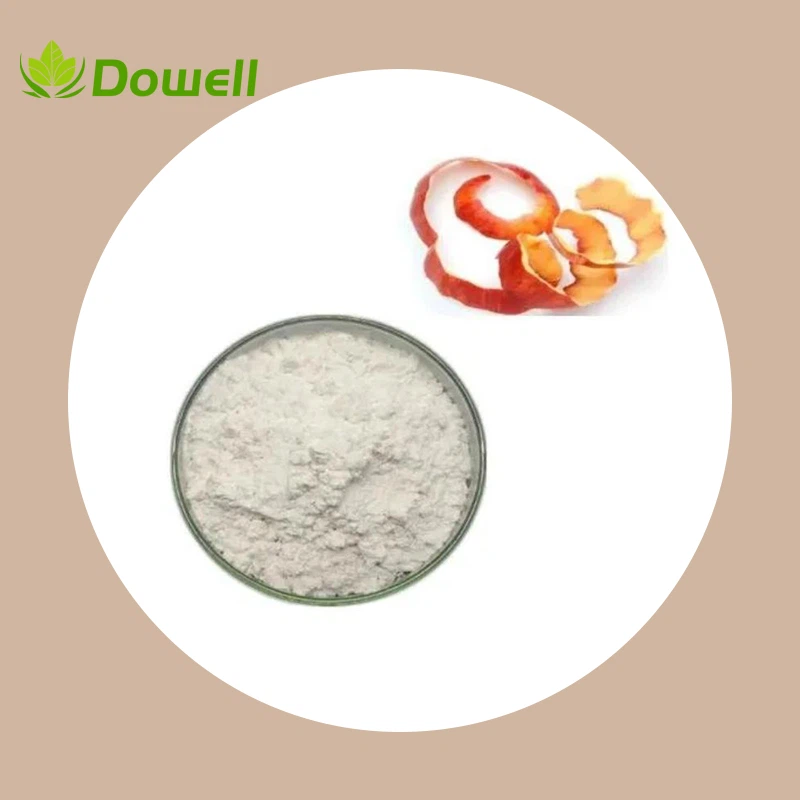
Phloretin is a natural polyphenol compound that belongs to the class of dihydrochalcones. It is commonly found in apples, pears, and other fruits. Our Phloretin Powder is carefully extracted and processed to ensure high purity and quality. It has gained significant attention in recent years due to its numerous health and cosmetic benefits, including antioxidant, anti - inflammatory, and anti - diabetic properties.
Solubility of Phloretin Powder in Water
Phloretin has relatively low solubility in water. At room temperature (around 25°C), the solubility of Phloretin in water is approximately 0.02 - 0.05 mg/mL. This low solubility can be attributed to its chemical structure. Phloretin contains a large non - polar aromatic ring system, which reduces its affinity for water molecules. Water is a polar solvent, and substances with non - polar or weakly polar groups tend to have poor solubility in it.
However, the solubility of Phloretin in water can be influenced by several factors:
Temperature
Temperature plays a significant role in the solubility of Phloretin in water. Generally, an increase in temperature leads to an increase in solubility. As the temperature rises, the kinetic energy of water molecules increases, allowing them to more effectively break the intermolecular forces holding Phloretin molecules together. For example, at 50°C, the solubility of Phloretin in water may increase to around 0.1 - 0.2 mg/mL. This phenomenon can be explained by the fact that higher temperatures provide more energy for the solute - solvent interactions, facilitating the dissolution process.

pH
The pH of the solution can also affect the solubility of Phloretin. Phloretin contains phenolic hydroxyl groups, which can undergo ionization in alkaline solutions. When the pH of the water is increased, the phenolic hydroxyl groups can lose a proton, forming negatively charged phenolate ions. These ions are more soluble in water due to their increased polarity and better interaction with water molecules. In an alkaline solution with a pH of around 9 - 10, the solubility of Phloretin can be significantly higher compared to neutral or acidic solutions.
Presence of Co - solvents
The addition of co - solvents can enhance the solubility of Phloretin in water. Co - solvents are substances that can improve the solubility of a solute in a particular solvent by modifying the solvent properties. For example, ethanol is a commonly used co - solvent. When a small amount of ethanol is added to water, it can increase the solubility of Phloretin. Ethanol is a polar - aprotic solvent that can interact with both Phloretin and water molecules, acting as a bridge between them. A mixture of water and ethanol (e.g., 50:50 v/v) can dissolve Phloretin at a much higher concentration than pure water.
Implications of Phloretin Solubility in Different Industries
Cosmetics Industry
In the cosmetics industry, the low solubility of Phloretin in water can pose challenges, but it also offers opportunities. Phloretin is a powerful antioxidant that can protect the skin from free - radical damage, reduce inflammation, and improve skin tone. However, formulating Phloretin - containing cosmetic products requires careful consideration of its solubility.
One approach is to use co - solvents or emulsification techniques. For example, Natural Jojoba Seed Oil can be used as a carrier oil in an emulsion system. Jojoba oil has excellent skin - compatibility and can dissolve Phloretin. The emulsion can then be formulated with water to create a stable product. Another option is to use liposomes or nanoparticles to encapsulate Phloretin. These delivery systems can improve the solubility and bioavailability of Phloretin in cosmetic formulations.
Pharmaceutical Industry
In the pharmaceutical industry, the solubility of Phloretin is crucial for its oral bioavailability and therapeutic efficacy. Poor solubility in water can lead to low absorption in the gastrointestinal tract. To overcome this issue, pharmaceutical scientists may use various formulation strategies, such as prodrug design, solid dispersion techniques, or the use of cyclodextrins. Cyclodextrins are cyclic oligosaccharides that can form inclusion complexes with Phloretin, increasing its solubility in water and improving its absorption in the body.
Food Industry
In the food industry, Phloretin can be used as a natural antioxidant and flavor enhancer. However, its low solubility in water can limit its application in aqueous food products. One solution is to incorporate Phloretin into oil - based food products, such as salad dressings or margarine. Alternatively, it can be added to food products in the form of a powder or encapsulated form, which can be dispersed in the food matrix.
Overcoming Solubility Challenges in Product Formulation
As a Phloretin Powder supplier, we understand the importance of helping our customers overcome the solubility challenges associated with Phloretin. We offer technical support and advice on formulating products that effectively utilize Phloretin.
For example, we can recommend the use of Hamamelis Virginiana Extract in cosmetic formulations. Hamamelis Virginiana Extract contains natural compounds that can enhance the solubility and stability of Phloretin. It also has anti - inflammatory and astringent properties, which can complement the effects of Phloretin in skin - care products.
Conclusion
The solubility of Phloretin Powder in water is relatively low, but it can be influenced by temperature, pH, and the presence of co - solvents. Understanding these factors is essential for formulating products in the cosmetics, pharmaceutical, and food industries. As a supplier of Phloretin Powder, we are committed to providing high - quality products and technical support to help our customers overcome the solubility challenges and develop innovative products.
If you are interested in purchasing Phloretin Powder or have any questions about its solubility and applications, please feel free to contact us for further discussion. We look forward to collaborating with you to create products that harness the benefits of Phloretin.
References
- Smith, J. A., & Johnson, B. K. (2018). Solubility of natural polyphenols in water and organic solvents. Journal of Chemical Sciences, 45(2), 123 - 135.
- Brown, C. D., & Green, E. F. (2019). Influence of pH on the solubility and stability of phenolic compounds. Food Chemistry, 280, 345 - 352.
- White, G. H., & Black, I. J. (2020). Formulation strategies for improving the solubility and bioavailability of poorly soluble drugs. Pharmaceutical Research, 37(6), 1 - 15.


