


Halal (commonly misspelled as HALA in business emails) originates from Arabic, meaning "lawful and permissible". A Halal Certificate is issued by officially authorized third-party Islamic certification bodies worldwide. It verifies that raw materials, formulas, production processes, warehousing and logistics of products fully comply with Islamic Sharia principles. The certification audit covers the whole supply chain rather than finished products only, including auxiliary raw materials, enzymes, flavors, solvents, production line separation and cross-contamination prevention. Products must be free from pork derivatives, prohibited animal ingredients, intoxicating alcohol and other forbidden substances. Apart from food, Halal standards are widely applied to pharmaceutical intermediates, personal care products, animal feed and packaging materials.
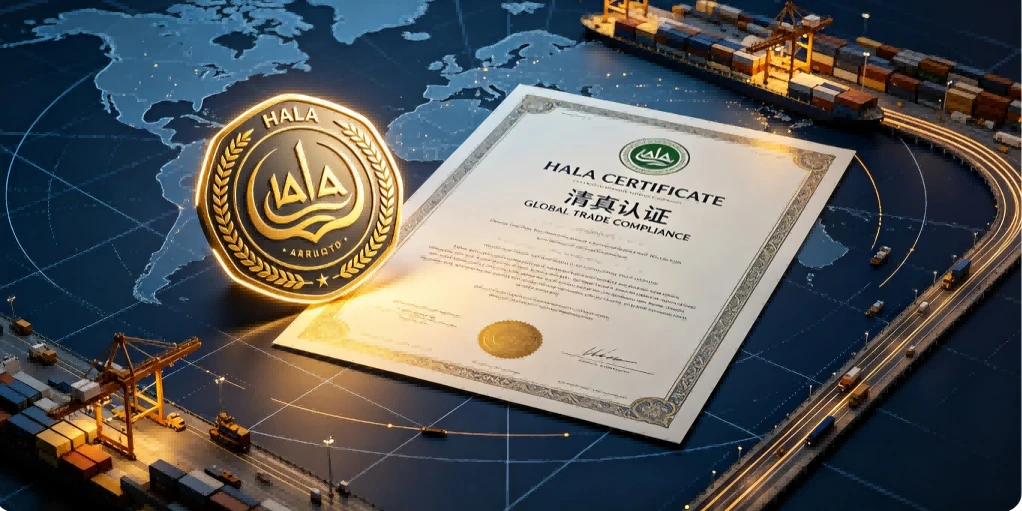
There are over 1.9 billion Muslim consumers globally. Major importing nations including Indonesia, Malaysia, Saudi Arabia, UAE and Pakistan implement varied Halal import regulations. Many governments treat valid Halal certificates as mandatory customs clearance documents. Shipments without recognized certification risk detention, fines and market sales bans, forming non-negotiable compliance barriers for international trade.
1. Core Importance of Halal Certification for Export Business
- Guarantee Market Access & Avoid Customs Risks Regulators in Southeast Asia and GCC countries require importers to provide Halal certificates issued by market-approved authorities. Domestic halal labels issued inside China are generally not accepted by overseas customs, which may lead to port detention or cargo return and massive logistics losses. Exporters should confirm recognized certification bodies (JAKIM Malaysia, MUI/BPJPH Indonesia, UAE official authorities etc.) before export arrangements.
- Build Trust with Overseas Buyers & Strengthen Competitive Edge Overseas importers, distributors and retail chains prioritize suppliers with valid Halal certification. A recognized certificate proves standardized supply chain management, reduces buyers' factory audit costs and creates obvious differentiation against competitors, supporting stable long-term B2B orders.
- Diversify Export Markets & Reduce Trade Risks With authoritative Halal certification, manufacturers can tap not only Middle Eastern and Southeast Asian markets with concentrated Muslim populations, but also Muslim communities across Europe and North America. It helps companies reduce reliance on single markets and mitigate geopolitical trade risks.
- Improve Supply Chain Traceability & Meet Global Quality Standards Full-chain Halal audits push enterprises to build complete raw material traceability systems, implement dedicated production zones and separated storage rules. Such management systems satisfy international buyers' universal requirements on food safety, ethical sourcing and sanitary production, lifting overall factory quality control standards.
2. Reference Value of Halal Certification for Chinese Exporters
- Firstly, correct common misunderstandings: Domestic halal labels for China domestic circulation cannot replace international Halal certification, and most Muslim sovereign states do not recognize local Chinese halal marks. Enterprises targeting overseas sales must apply for internationally accepted Halal certificates. In addition, certification standards between different countries are not mutually recognized universally. No single certificate can access all Muslim markets; verify local requirements in advance.
- Secondly, arrange compliance planning in advance: Evaluate Halal certification feasibility during new product development or production line renovation. Prevent certification failure caused by shared production lines or untraceable raw materials to cut extra costs and time delays.
- Thirdly, upgrade international marketing materials: List Halal certification in company qualification documents, display certificates on independent websites, product pages, sales letters and exhibition brochures to attract buyers from Muslim consumer markets.
- Fourthly, prevent commercial disputes: Clearly specify Halal standard requirements for target markets within sales contracts, define compliance liabilities to avoid compensation claims resulting from unqualified certification documents.
Industry analysts comment that the Muslim consumer market maintains steady growth under the new global trade landscape. For numerous export sectors, Halal certification has shifted from an optional advantage to a basic market entry requirement. Chinese exporters shall arrange certification plans according to destination country regulations, consolidate cross-border compliance capacity and seize promising export opportunities in this blue-chip market.


