


Ascorbic acid, commonly known as Vitamin C, is an essential water-soluble antioxidant widely applied in food additives, feed nutrition, cosmetic formulation, pharmaceutical production and dietary supplement industries. In international bulk trade, ascorbic acid is mainly divided into two commercial specifications: uncoated ascorbic acid and coated ascorbic acid. Many global buyers and manufacturers fail to distinguish their application scenarios, stability performance and cost differences, resulting in improper material selection and product quality loss. This article systematically elaborates the core differences between coated and uncoated ascorbic acid in terms of production technology, stability, solubility, application scope and trade value, providing professional reference for international procurement, formula development and industrial production.
1. Production & Structural Differences
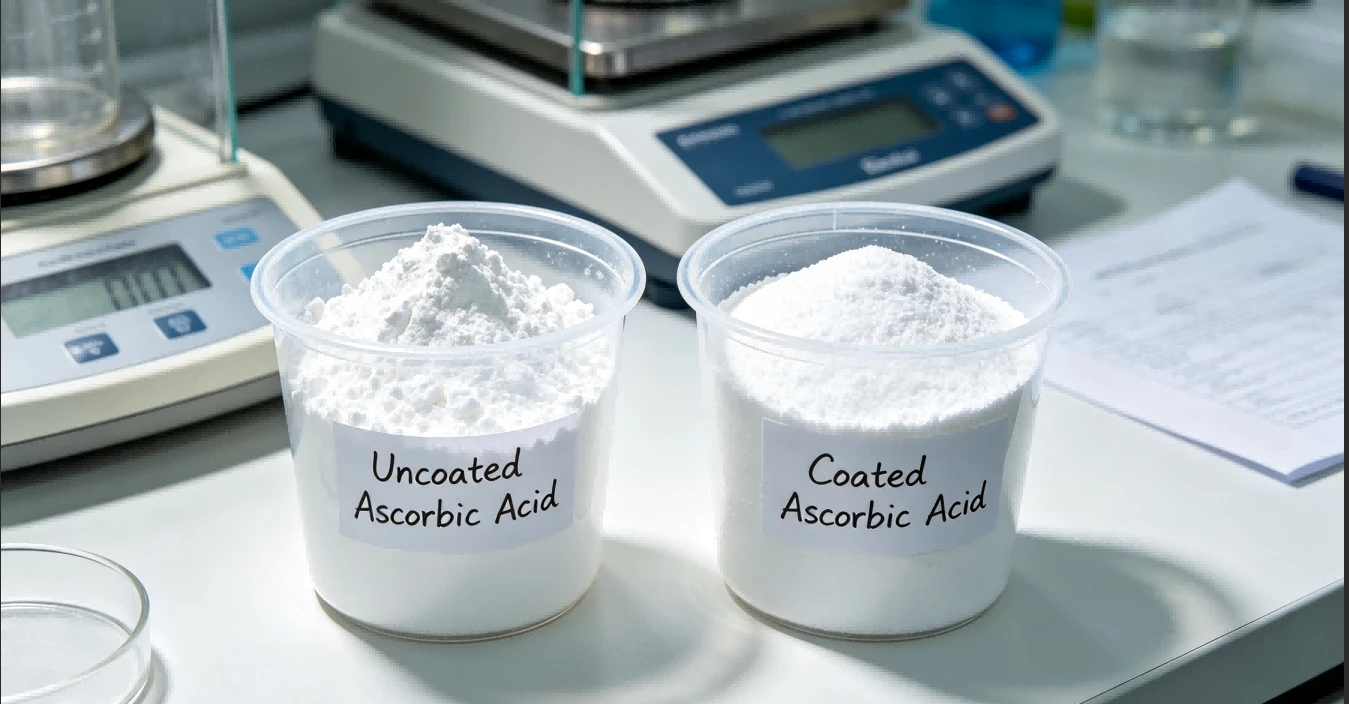
Uncoated ascorbic acid is the original crystalline powder of L-ascorbic acid without any surface modification. It adopts traditional crystallization and drying technology, with pure and simple molecular structure, no auxiliary coating ingredients, and high single-component purity, which is the most conventional and cost-effective basic specification in the market.
Coated ascorbic acid is a modified upgraded product. It forms a dense hydrophobic protective film on the surface of ascorbic acid crystals through physical coating technology with edible fatty acid, polymer or vegetable fat coating materials. The coating layer tightly wraps the vitamin C molecules, realizing physical isolation between active ingredients and external environment. The mainstream commercial specifications in international trade are 90% and 97% coated ascorbic acid, with stable coating uniformity and no easy shedding.
2. Stability & Storage Performance Differences
Stability is the most critical difference between the two products. Uncoated ascorbic acid is highly sensitive to oxygen, moisture, high temperature, light and metal ions. During long-term storage, high-temperature processing and extrusion production, it is prone to oxidative degradation and moisture agglomeration, which will reduce active content, cause raw material yellowing, and affect the shelf life and quality of finished products. In humid cross-border logistics and ocean transportation environments, uncoated vitamin C is more susceptible to quality attenuation.
With the protection of the hydrophobic coating layer, coated ascorbic acid effectively isolates moisture and oxygen, inhibits autoxidation reaction, and greatly improves thermal stability and environmental adaptability. It can withstand high-temperature granulation, tableting and feed extrusion processes, and maintains stable active ingredients during long-distance ocean transportation and long-term warehouse storage. This feature makes it the preferred material for high-standard industrial production and export-oriented finished products.
3. Solubility & Release Characteristics
Uncoated ascorbic acid has excellent water solubility, which can be rapidly dissolved and dispersed in water-phase systems, with fast absorption and immediate antioxidant effect. It is suitable for products requiring rapid vitamin supplementation and instant antioxidant reaction.
Coated ascorbic acid is insoluble in pure water in the initial stage and presents slow-release characteristics. The protective coating will gradually disintegrate and release active ascorbic acid under neutral and weak alkaline conditions or after entering the lipid-soluble environment of the organism. The slow-release mechanism avoids the rapid loss of active ingredients, prolongs the action time of vitamin C, and improves bioavailability in animal nutrition and human health products.
4. Industrial Application Scenarios
Uncoated Ascorbic Acid Applicable Scenarios: It is widely used in liquid beverages, fruit juice, preserved fruits, ordinary food additives, water-soluble cosmetic formulas and common oral tablets. It is suitable for normal temperature processing, short storage cycle and water-phase production systems, with low cost and high cost performance, meeting the basic production needs of most civilian products.
Coated Ascorbic Acid Applicable Scenarios: It is mainly used in high-temperature processed feed additives, puffed food, solid health care products, high-grade dietary supplements and long-shelf-life export products. It is especially suitable for cross-border export industries with harsh transportation conditions and strict quality standards, and can effectively reduce product defect rate and after-sales quality problems in international trade.
5. International Trade & Procurement Suggestions
In international bulk transactions, uncoated ascorbic acid dominates the low and medium-end market with low unit price and sufficient supply, and is the mainstream choice for daily chemical and ordinary food industries. Coated ascorbic acid belongs to high-value modified raw materials, with higher unit price, but obvious advantages in processing tolerance and storage stability, and is more popular in high-end feed, pharmaceutical and export health product markets.
For cross-border buyers, it is necessary to select specifications according to production technology and product positioning. For liquid normal-temperature products with short sales cycle, uncoated ascorbic acid is sufficient to control costs; for solid products, high-temperature processed products and export products with long logistics cycles, coated ascorbic acid is a must to ensure stable product quality and compliant shelf life.
The core difference between coated and uncoated ascorbic acid lies in surface modification technology, which further leads to differences in stability, solubility, release effect and application scenarios. Uncoated ascorbic acid is cost-effective and suitable for conventional water-phase and normal-temperature production; coated ascorbic acid features high stability and slow release, adapting to high-temperature processing and long-distance export transportation. Mastering the differences between the two specifications can help international traders, manufacturers and purchasers optimize material selection, reduce production losses and improve product market competitiveness.


